Why Planning Matters for Custom Gates
A custom metal gate is an investment in security, functionality, and property appearance. Unlike mass-produced gates that come in standard sizes and limited designs, a custom gate is built to fit your specific opening, match your property's style, and meet your particular requirements. But getting these benefits depends on proper planning before fabrication begins.
At Micha Solution Welding in Hialeah, Florida, we fabricate and weld custom metal gates for residential, commercial, and industrial properties throughout Miami-Dade County. With 15 years of experience, we have built gates for driveways, entrances, access points, and security applications — each one designed around the specific property and the owner's requirements. This guide covers the key considerations for planning a custom metal gate project.
The goal of planning is not to make the project complicated. It is to ensure that the finished gate fits the opening precisely, performs reliably, looks the way you want it to, and withstands the conditions it will face. The more thought you put into planning, the better the result will be.
Measuring the Opening
Accurate measurement is the foundation of a successful custom gate project. The gate must fit the opening precisely — too narrow and there are gaps; too wide and it will not fit at all. Measuring seems straightforward, but there are nuances that can affect the fit if they are overlooked.
The first measurement is the opening width — the distance between the posts or walls where the gate will be installed. This should be measured at the top, middle, and bottom of the opening, because openings are not always perfectly square. If the measurements differ, the gate must be fabricated to accommodate the variation, or the opening must be adjusted.
The second measurement is the opening height — the distance from the ground to the desired top of the gate. Ground level should be checked along the opening, because uneven ground can cause the gate to bind or drag. If the ground is uneven, the gate may need to be fabricated with a bottom edge that follows the ground contour, or the ground may need to be leveled.
The third consideration is the post or mounting surface. If new posts are needed, they must be sized for the gate's weight and the loads it will experience. If existing posts are being used, they must be evaluated to ensure they are strong enough and in good condition. A heavy gate on a weak post is a problem waiting to happen.
Finally, consider the swing or slide direction. A swing gate needs clearance to open — if the opening is at the edge of a property, there may not be room for the gate to swing inward. A slide gate needs a clear path along the fence line. The available space determines which type of gate is practical for your opening.
Choosing the Right Material
The material you choose for your custom metal gate affects its strength, appearance, durability, and maintenance requirements. Steel is the most common material for custom gates because it offers an excellent combination of strength, weldability, and cost. It can be fabricated into virtually any design, from simple and functional to elaborate and decorative.
Within steel, there are options in terms of shape and profile. Steel tubing is commonly used for gate frames because it provides strength in a clean, rectangular profile. Steel bars and solid shapes can be used for decorative elements. Sheet steel can be used for panel gates. The choice depends on the design, the loads, and the aesthetic you want to achieve.
Material thickness is an important consideration. Thicker material is stronger but heavier and more expensive. Thinner material is lighter and less expensive but may not have the rigidity needed for a large gate. The appropriate thickness depends on the gate size, the design, and the loads it will experience, including wind loads in South Florida.
For gates that will be exposed to South Florida's weather, protective coating is essential. Without it, steel will rust and deteriorate over time. Common options include paint, powder coating, and galvanizing. The choice depends on the exposure conditions, the expected service life, and the appearance you want. A properly coated gate can last for many years with minimal maintenance.
In some cases, alternative materials may be considered. Aluminum is lighter and corrosion-resistant but has lower strength than steel. Stainless steel offers excellent corrosion resistance but is significantly more expensive. For most custom gate applications in South Florida, steel with proper protective coating is the practical choice.
Design Considerations
The design of a custom metal gate balances function, strength, and appearance. The gate must perform its primary function — controlling access to the property — while also withstanding daily use, weather, and potential abuse. At the same time, it is one of the most visible elements of a property, so its appearance matters.
Functional design considerations include the gate type (swing, slide, or bi-fold), the latch and hinge hardware, and the clearance needed for operation. The gate must be designed to open and close smoothly, latch securely, and withstand the forces of wind and use. A gate that binds, drags, or does not latch properly is a constant source of frustration.
Structural design considerations include the frame design, the bracing, and the connection points. A gate frame must be rigid enough to resist sagging and twisting, which means the design must include appropriate bracing. The connections between frame members must be strong enough to transfer the loads. The hinge points must be designed to carry the gate's weight and withstand the repeated stress of opening and closing.
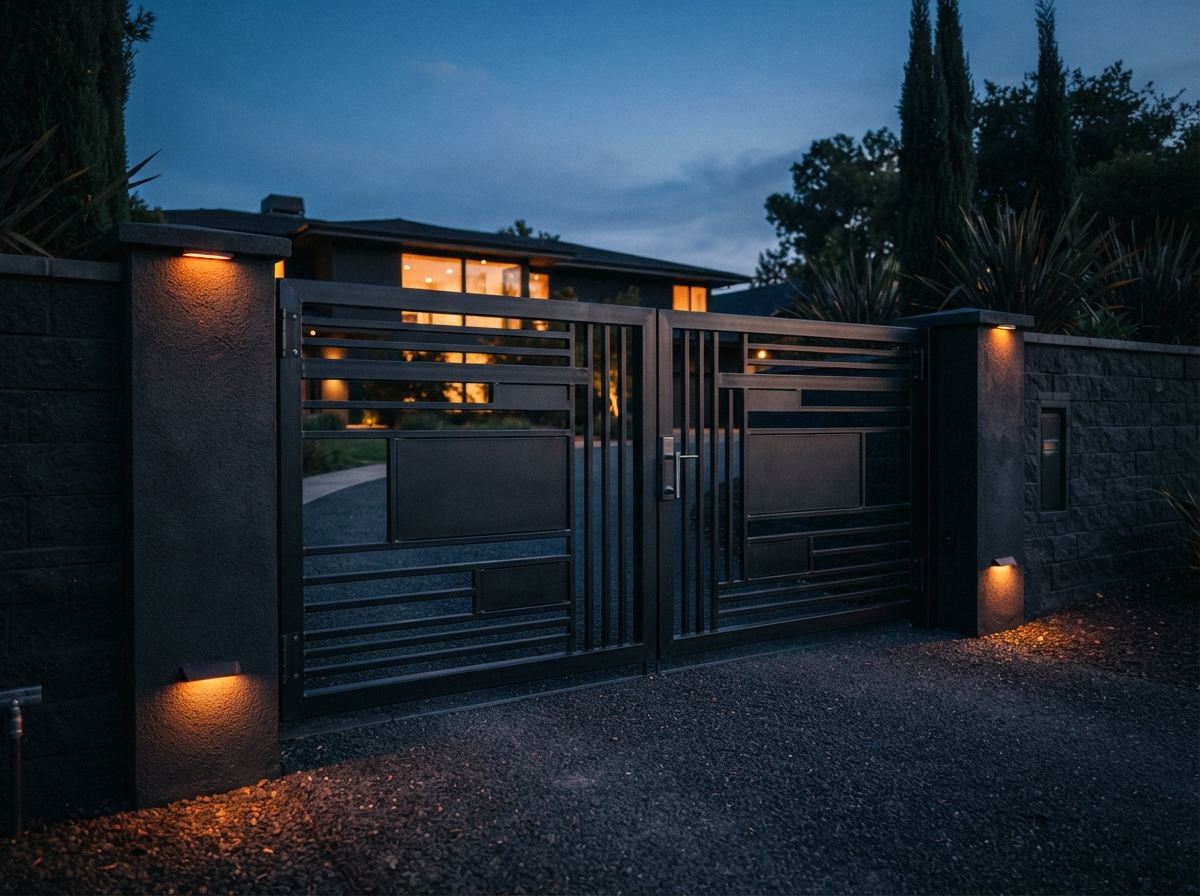
Aesthetic design considerations include the style, the infill pattern, and the finish. A gate can be simple and functional — a plain frame with vertical bars — or it can be elaborate and decorative — with scrollwork, panels, or custom elements. The style should complement the property and any existing metalwork. The finish should be appropriate for the exposure conditions and the desired appearance.
At Micha Solution Welding, we work with clients to develop gate designs that balance these considerations. We can fabricate from your drawings or photos, or we can develop a design based on your description and requirements. The goal is a gate that performs reliably and looks the way you want it to.
Installation Considerations
Installation is a critical part of a custom gate project. Even a well-fabricated gate will not perform properly if it is installed incorrectly. The posts must be set plumb and secure, the hinges must be aligned, the latch must engage properly, and the gate must swing or slide without binding.
For new installations, the posts are typically set in concrete footings. The footing depth and diameter depend on the gate size, the soil conditions, and the loads. In South Florida, footings must be deep enough to provide stability in sandy soil and to resist wind loads on the gate. The posts must be set plumb and at the correct spacing for the gate width.
For installations using existing posts, the posts must be evaluated for strength, condition, and alignment. If the posts are weak, damaged, or out of alignment, they may need to be repaired or replaced before the gate can be installed. Installing a new gate on inadequate posts is a recipe for problems.
Hinge selection and installation are critical. The hinges must be strong enough to carry the gate's weight, properly aligned to allow smooth operation, and securely attached to the posts. For heavy gates, heavy-duty hinges are essential. The hinge placement affects how the gate hangs and operates, so it must be done correctly.
At Micha Solution Welding, we handle gate installation as part of the project. This ensures that the gate is installed correctly and operates properly, without the coordination challenges that can arise when fabrication and installation are handled by different parties.
Maintenance and Longevity
A custom metal gate is a long-term investment, and proper maintenance extends its service life. The maintenance requirements depend on the material, the finish, and the exposure conditions. In South Florida's humid, salt-air environment, maintenance is particularly important because the conditions are harsh on metalwork.
For painted or powder-coated gates, the finish should be inspected periodically for chips, scratches, or areas where the coating has failed. Any damaged areas should be touched up to prevent corrosion from starting. If the finish has deteriorated significantly, repainting may be needed to protect the metal.
For galvanized gates, the zinc coating provides corrosion protection without the need for painting. However, the coating can be damaged by impact or abrasion, and damaged areas should be repaired to maintain protection. Galvanized gates generally require less maintenance than painted gates in corrosive environments.
Hardware — hinges, latches, and locks — should be inspected periodically and lubricated as needed. Hinges that are not lubricated can wear prematurely and cause the gate to bind. Latches that are not adjusted properly can fail to engage or become difficult to operate. Regular maintenance of the hardware keeps the gate operating smoothly.
Finally, the gate should be inspected for structural damage — cracks in welds, bent frame members, or loose connections. Any damage should be repaired promptly to prevent it from worsening. A small crack in a weld can grow over time and eventually cause the gate to fail.
Getting Started
If you are planning a custom metal gate project, the best way to start is by gathering information. Measure the opening, take photos of the site, and think about what you want the gate to accomplish — security, access control, property improvement, or a combination. The more information you can provide, the more accurately the project can be planned and estimated.
Contact Micha Solution Welding with the details of your project. Based in Hialeah, Florida, we fabricate and install custom metal gates for residential, commercial, and industrial properties throughout Miami-Dade County. With 15 years of experience, we evaluate each project individually and build gates that fit the opening, perform reliably, and look the way you want them to.
Call us at (305) 515-0490 or request a free estimate online. Share the details of your project — measurements, photos, design preferences — and we will evaluate the requirements, plan the fabrication, and provide a personalized quote. Whether you need a simple residential driveway gate or a heavy-duty commercial entrance gate, we bring the same attention to detail and commitment to quality that custom metalwork demands.
Frequently Asked Questions
How wide should a driveway gate be?
Driveway gate width depends on the vehicle access needed. A single-width gate typically needs at least 10 feet of clear opening, while a double-width gate may need 16 to 20 feet. The exact width should account for the largest vehicle that will use the gate and any clearance needed for turning.
What is the best material for a metal gate in South Florida?
Steel is the most common material for custom metal gates due to its strength and weldability. In South Florida's humid, salt-air environment, proper protective coating is essential to prevent corrosion. The coating should be selected based on the gate's exposure to weather and salt.
Can a custom metal gate match an existing fence or railing?
Yes. If you have existing metalwork, share photos or details of the style, material, and finish. We can assess what is needed to match or complement the existing work in the new gate design.
Have a Welding Project in Mind?
Tell us what you need and get a personalized estimate — or call us directly.